Prompt customization
Biel.ai offers two modes for controlling how the chatbot responds: Default prompt (optimized for technical documentation) and Custom prompt (full control).
Default prompt
The default prompt gives clear, step-by-step technical answers based on your documentation. It asks clarifying questions when a request is unclear and says when the documentation does not contain enough information instead of guessing.
You can extend the default prompt with additional instructions—for example, adding a signature to responses or modifying the tone. Prompt extensions are limited to 6,000 characters.
Custom prompt
Write your own prompt for full control over the chatbot's behavior. Custom prompts are limited to 8,000 characters.
Custom prompts may disable built-in safeguards and advanced processing features.
Configure the prompt
Only Administrator or Maintainer roles can manage projects. See Manage roles.
-
In the Biel.ai dashboard, select your project.
-
Click Settings.
-
Open Chatbot in the left sidebar and, under AI model and instructions > Define prompt:
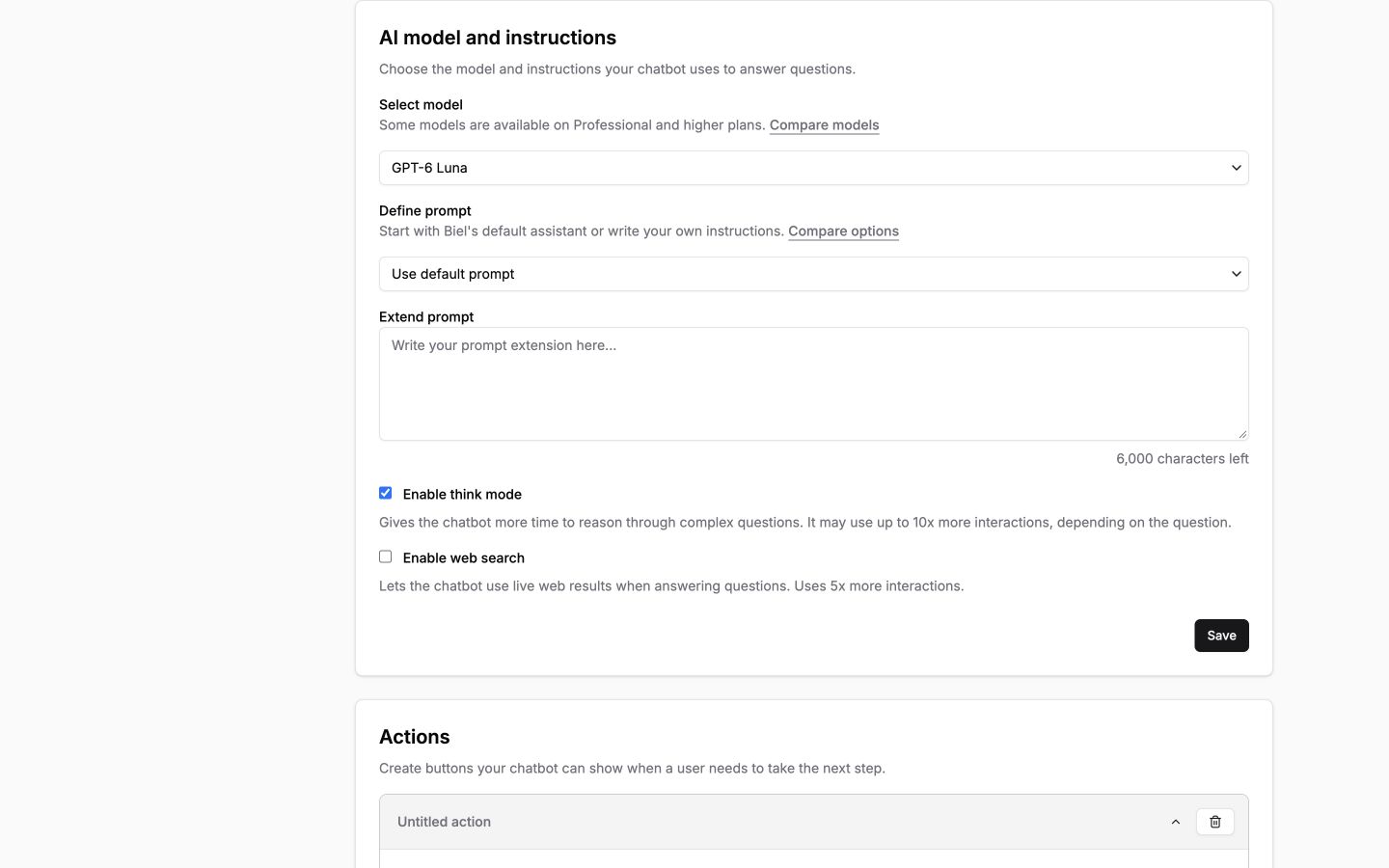
- Select Use default prompt and optionally add instructions in Extend prompt, or
- Select Custom prompt and write your full instructions in Extend prompt.
-
Click Save on the AI model and instructions card.
Examples
Extending the default prompt:
Always start responses with "Hi!"
Custom prompt:
You are a customer support assistant for [Product Name]. Provide clear, accurate answers related to product features, troubleshooting, and usage. Keep responses professional and focused on the product. Only respond based on the information you can extract from CONTEXT and the conversation HISTORY.