Search
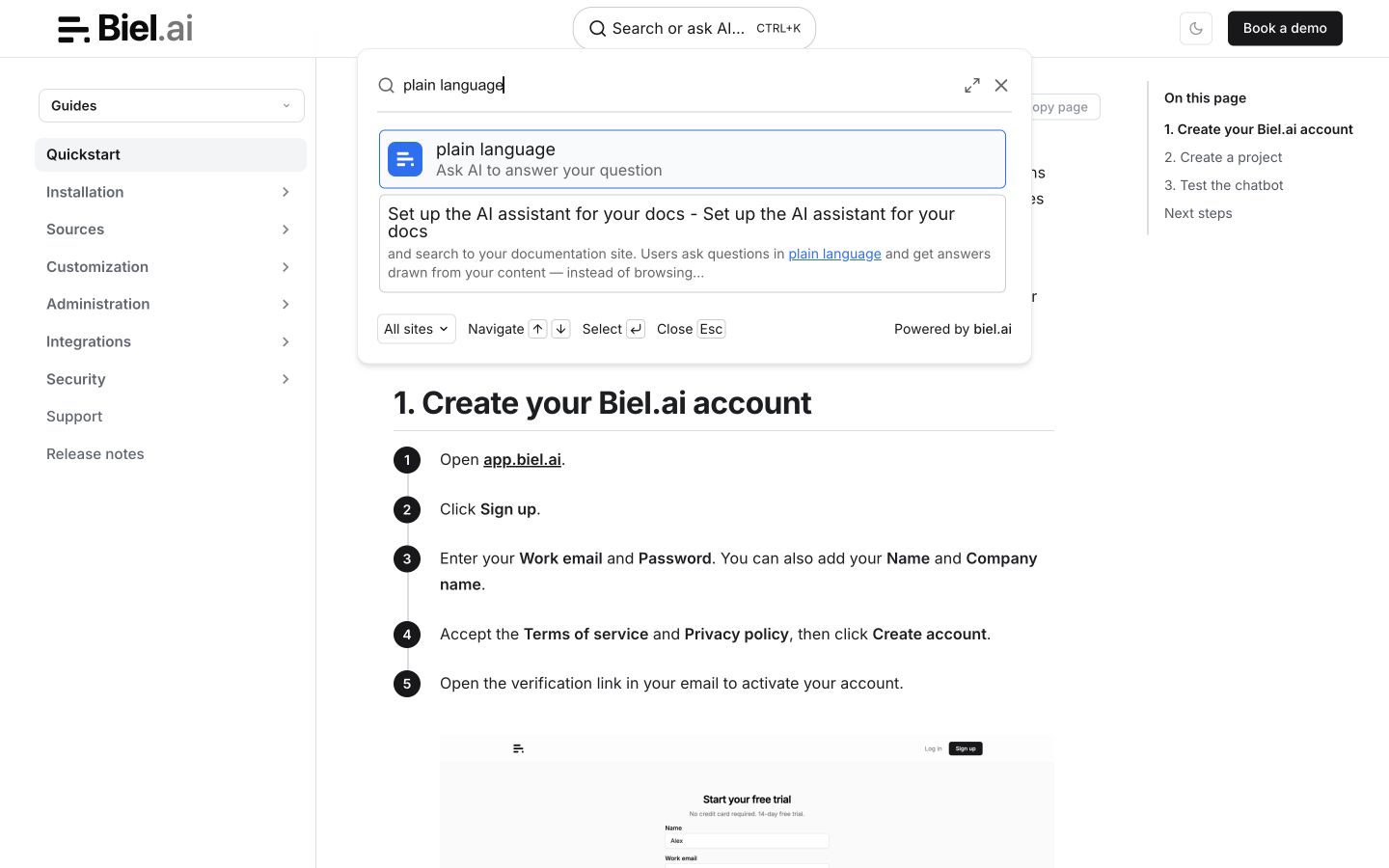
The search widget finds documentation pages and sections across your indexed website content. Users can select Ask AI to turn a question into an assistant conversation.
How search works
The widget uses keyword search across the page title, description, section headings, keywords, and content. Title matches receive additional weight, and results can link directly to the matching section.
Each successful search counts as one interaction. Ask AI uses assistant interactions in addition to the search. Both count toward your team's included allowance and cost $0.05 each beyond that allowance when extra usage is enabled.
Text relevance is normalized between 0 and 1 before applying boosts. The final score can exceed 1 when a positive boost is added.
You can adjust rankings with a boost score: positive values (e.g., 0.5) increase a page's ranking, negative values (e.g., -0.5) decrease it. The final score is the base score plus the boost.
Pages with a combined boost of -1.0 or lower are excluded from search results. Smaller negative boosts lower their ranking.
Installation
Customization
Widget appearance
See Layout for styling and positioning options.
Search filters
You can configure filters that let users narrow search results by category (for example, API, Guides, Blog). For details, see Search filters.
Metadata and keywords
Add meta tags to improve how your content is indexed and ranked:
<meta name="description" content="Learn how to configure and customize your Biel.ai assistant">
<meta name="keywords" content="assistant, configuration, customization, Biel.ai, setup">
For Docusaurus, Sphinx, and other documentation systems, see Metadata by platform.
Boost search results
Use boost scores to prioritize certain pages. For example, boost guides by 0.5 so they rank higher, while leaving reference pages at 0 for natural ranking.
If your team has access to Boost Rules, open Settings > Search, add a URL pattern and boost score, and click Save on that card. Click Refresh sources to apply the rule to indexed pages. A matching rule's boost is added to the page's metadata boost.
Add the following meta tag to the head of the page:
<meta name="biel:boost_score" content="0.5">
Click Refresh sources after updating page metadata so Biel.ai indexes the change.
For Docusaurus, Sphinx, and other documentation systems, see Metadata by platform.
Metadata by platform
- Docusaurus
- Sphinx
Add the head tag directly in your markdown content:
---
title: Search Configuration
---

<head>
  <meta name="description" content="Learn how to configure and customize your Biel.ai assistant" />
  <meta name="keywords" content="assistant, configuration, customization, Biel.ai, setup" />
  <meta name="biel:boost_score" content="0.5" />
</head>

# Search Configuration

Your content here...
Use the meta directive in your reStructuredText files:
.. meta::
   :description: Learn how to configure and customize your Biel.ai assistant
   :keywords: assistant, configuration, customization, Biel.ai, setup
   :biel:boost_score: 0.5

Search Configuration
====================
Limitations
The search widget returns website pages. Uploaded files, repository files, and OpenAPI specifications can inform assistant answers but do not appear in the widget's page results. The API and MCP all-content search can retrieve those sources.