Manage projects
Projects are the core organizational unit in Biel.ai where you configure your assistant's behavior, data sources, and security settings.
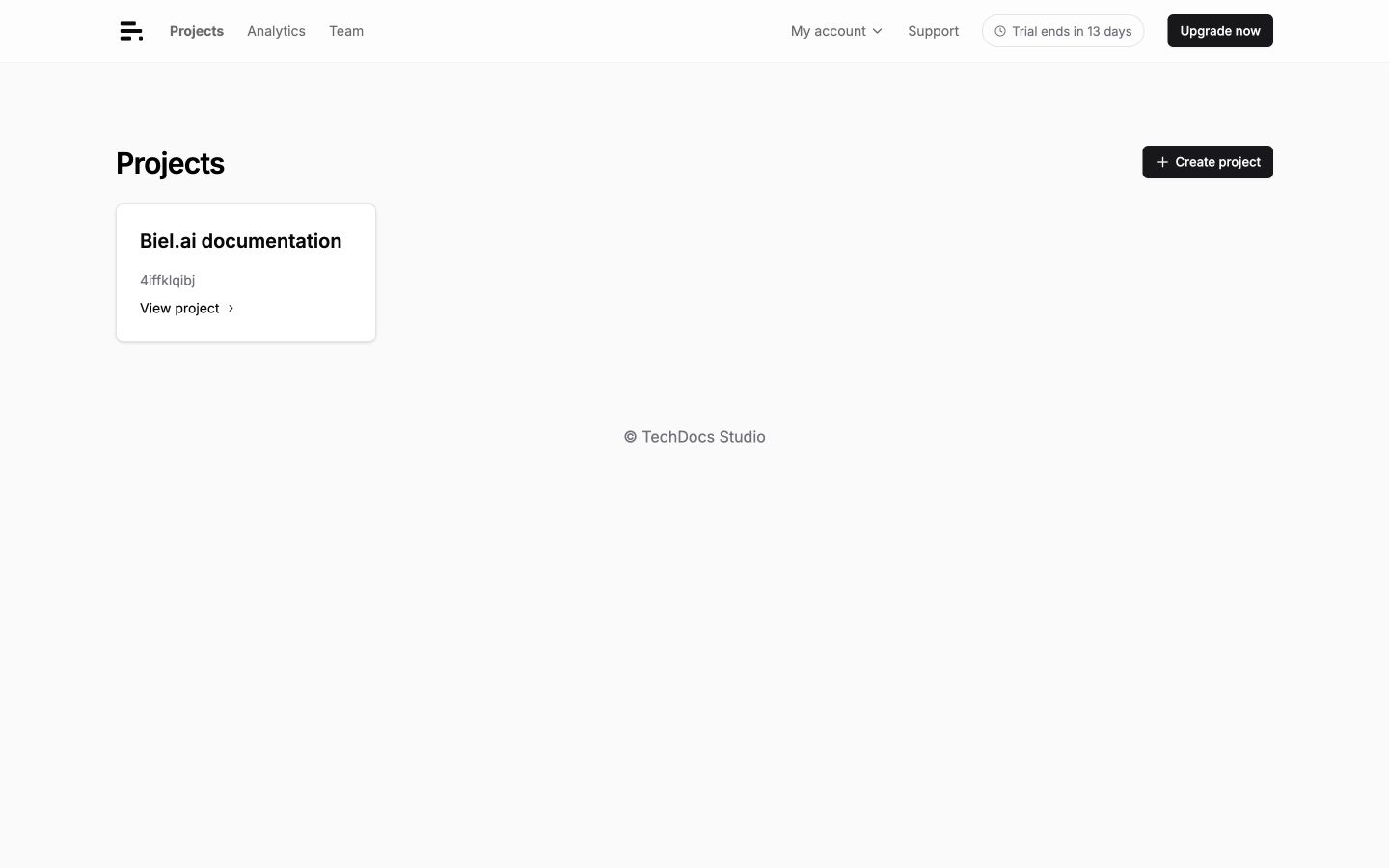
View all projects
The Projects dashboard displays a list of all your projects.
Starter, Professional and Business include unlimited projects.
After your trial ends, choose a paid plan to reactivate your projects.
Project detail page
From the Projects dashboard, click on a project name to open its detail page.
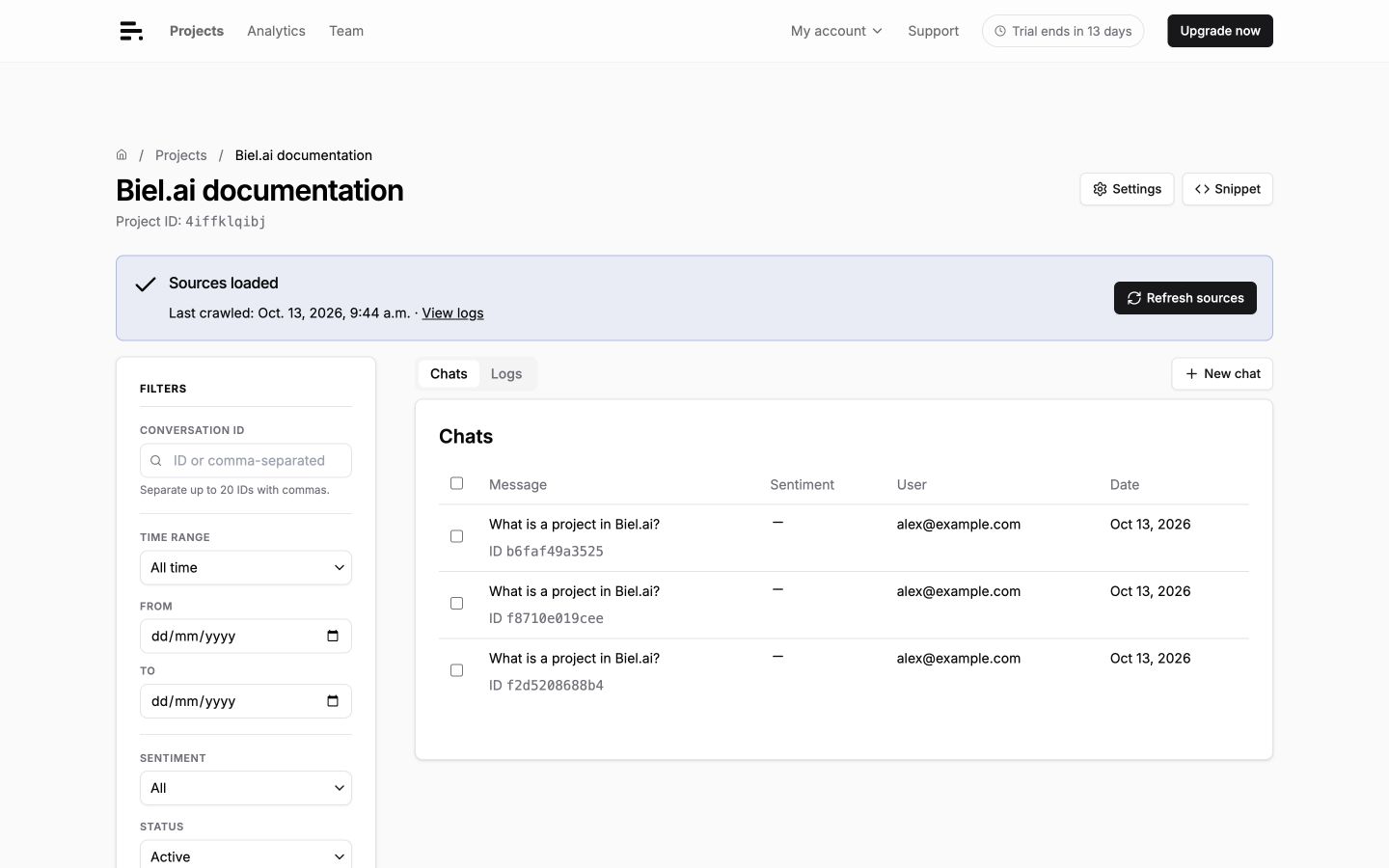
Here you can:
Project information
- View the project ID
- Click Snippet to choose AI Assistant or AI Search and copy its installation code
- Access the project details using the Settings button
Testing and monitoring
- Click New chat to open the assistant in a modal and test its answers
- Click Refresh sources to recrawl content and check the Sources loading or Sources loaded status
- Open Logs or View logs to troubleshoot indexing issues
- Open Analytics in the top navigation bar and select this project to review assistant, MCP, and search usage
- Click Demo to open the public demo page, when enabled
Chat management
- View all chat entries and conversation history
- Filter conversations by date, sentiment, status, or metadata
- Find a conversation by entering any four or more characters from its ID; separate multiple IDs with commas
- Click on any chat entry to view its details
Project actions
- Open Settings > General, then click Delete project at the bottom of the page
Chat detail view
From the project detail page, click on any chat entry in the conversation list to view its full details.
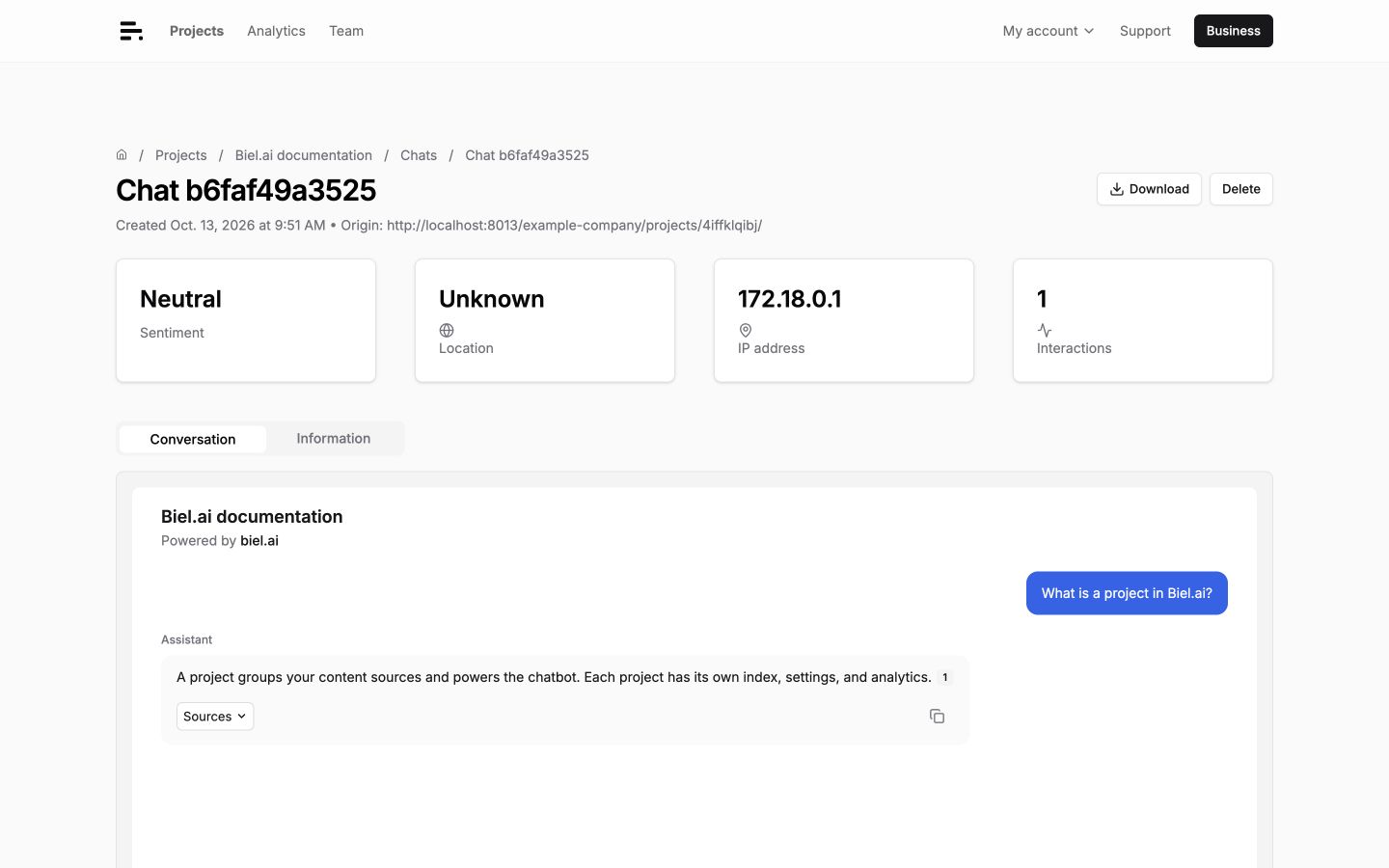
This view shows detailed information about that specific conversation:
User information
- Email address (if provided)
- Country and IP address
- Sentiment analysis of the conversation
Conversation metadata
- URL where the chat originated
- Date and time of the conversation
- Full conversation history
Actions
- Download: Export the chat in PDF, Excel, or CSV format
- Delete: Remove the chat entry
Bulk actions
Select chat entries using the checkboxes, choose an option from Select action, and click Apply:
- Archive selected: Move conversations to the archived list while preserving their history. Set the Status filter to Archived to view them and use Unarchive selected to restore them.
- Export selected to CSV, Export selected to XLS, or Export selected to PDF: Download selected conversations.
- Delete selected: Remove selected conversations from the dashboard.
Project settings
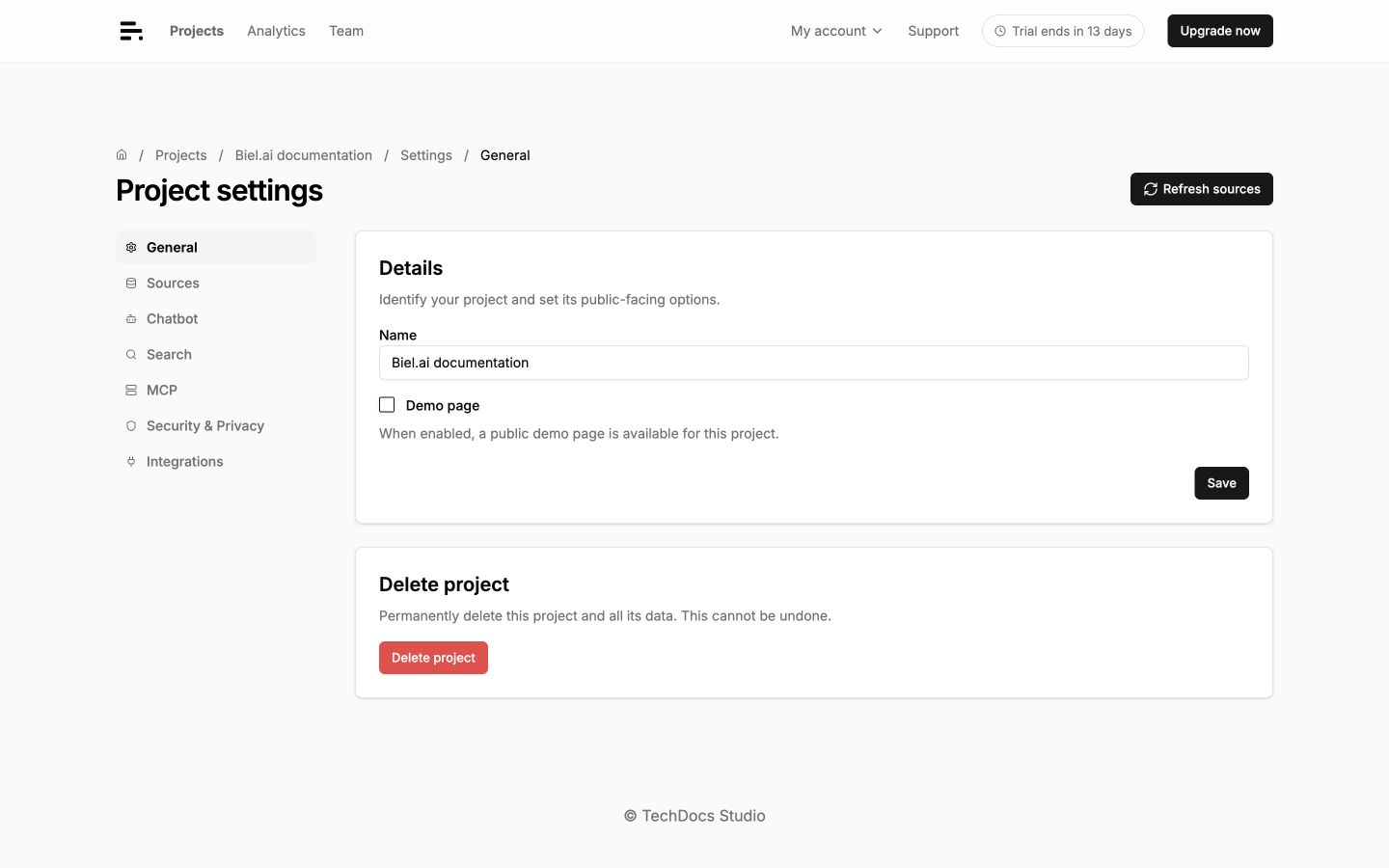
From the project detail page, click the Settings button (top right) to open the project settings. The settings layout has a left sidebar with seven groups; each group has its own page with one or more sections.
Only Administrator or Maintainer roles can manage project settings. See Manage roles.
The header on every settings page has a Refresh sources button:
- Refresh sources: Re-crawl all configured sources. After clicking, you're sent to the project's chat-list page where the loading status is visible.
To permanently delete a project and all its data, open General and use the Delete project section at the bottom of the page.
Each section card has its own Save button. On Sources, one Save button saves the configuration across all source types. File uploads are saved as soon as they finish. Click Refresh sources after changing sources to index the updated content.
General
Basic project information:
- Name: Display name for the project.
- Demo page: Enable or disable the public demo page used for testing.
Sources
Configure the data sources your assistant can answer from. Pick a source type from the chip selector at the top of the page; each chip reveals its own form.
- URLs: Index specific web pages.
- Sitemaps: Index entire websites using XML sitemaps. The Sitemaps tab also exposes URL-filter regex patterns to control which sitemap URLs get crawled.
- GitHub: Index GitHub repositories directly.
- OpenAPI: Import API specifications.
- Confluence: Connect a Confluence workspace.
- Files: Upload documents (PDF, CSV, Excel, Word, TXT, MD). Available once the project has been created.
For detailed configuration, see Sources.
Assistant
Three sections, each with its own Save button:
- Conversation — the Welcome message and suggested questions shown when the chat opens. See Initial message and Suggested questions.
- AI model and instructions — model selection, prompt configuration (default prompt or custom prompt), think mode, and web search. See Models, Custom prompt, and Reasoning modes.
- Actions — buttons the assistant can suggest when users need to take a next step. See Actions.
Search
Two sections:
- Search Filters — filter chips that narrow search results by URL pattern. See Search filters.
- Boost Rules — rank specific URLs higher in search results. Available with the boost permission.
MCP
Configure Model Context Protocol integration so AI coding assistants can talk to this project.
- Enable MCP server: Allow access through MCP.
- MCP server name: Custom name using letters, numbers, hyphens, and underscores, such as
acme-docs. Leave blank to use the project name. - Metadata tag: Tag used to identify conversations originating from MCP.
Available during your trial and on Professional and higher plans. See MCP server.
Security & Privacy
Two sections:
- Data Privacy — toggle PII redaction and IP-address collection. See Data privacy.
- Access Control — require authentication for API access (Business plan), and restrict which domains the assistant widget runs on.
Integrations
Connect channel integrations from their cards. Discord and Slack have a Connect button that opens authorization. Microsoft Teams provides a downloadable manifest and a setup token. Each integration has its own setup controls.
- Discord — see Discord.
- Slack — see Slack.
- Microsoft Teams — see Microsoft Teams.
Crawl scheduling and limits
Besides the manual Refresh sources trigger, Biel.ai recrawls some projects automatically, and applies limits so crawls stay within your plan and finish in a reasonable time.
Automatic recrawl schedule
Biel.ai recrawls a project's sources automatically based on your team's plan:
| Plan | Automatic recrawl frequency |
|---|---|
| Business | Every week |
| Professional, Growth | Every 30 days |
| Other plans | None — trigger crawls manually with Refresh sources |
A custom team agreement can override the recrawl interval.
The interval is measured from the start of the last crawl, regardless of whether that crawl succeeded or failed. A project that has never been crawled waits for a manual first crawl, and a project with a crawl already running is skipped until that crawl finishes.
To recrawl a project outside this schedule, or on a plan without automatic recrawl, click Refresh sources.
Source limit enforcement
Plans can limit the total number of indexed pages across all of a team's projects. The Indexed pages usage card on the subscription page shows the pages from the last crawl of each project, pooled across the team. If a crawl would exceed the allowance, Biel.ai stops indexing and emails the team. Reduce the content included in your sources or upgrade your plan, then click Refresh sources again.
Crawl time limit
Biel.ai uses a 2-hour soft limit for crawls. Crawls that run significantly longer may be canceled.
If your crawls are consistently hitting this limit, contact us for guidance